Project Overview
What is Hydroponics?
Hydroponics is the cultivation of plants in water, rather than soil. While untraditional, hydroponics allows farmers more control over the growing conditions of their crops; nutrient solutions can be customized, temperature can be controlled, and hydroponic plants are less prone to pests. Such a level of control enables farmers to maximize their crop yield. Additionally, hydroponics avoids water loss to soil drainage, so it requires less water than traditional farming, and it can be configured to be more space efficient. In a world that is being so heavily affected by climate change, hydroponics is one way to grow food in a sustainable and ecologically sound way.
Project Goal
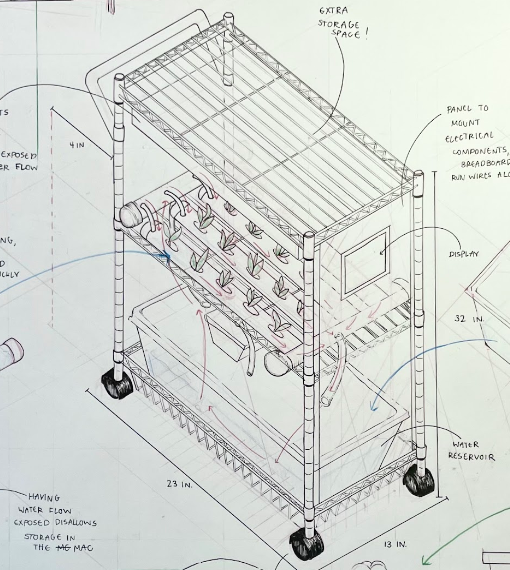
We wanted to create this hydroponics system for everyday people looking to grow veggies, herbs, and other plants in their homes, more easily. In deciding what we wanted our garden to look like, we first considered constraints that our user segment might have for such a system: space, aesthetics, modularity and mobility. Given these constraints, we decided to implement our design onto a multi-tiered cart.
Shown below is a concept sketch for the final product.
Our MVP
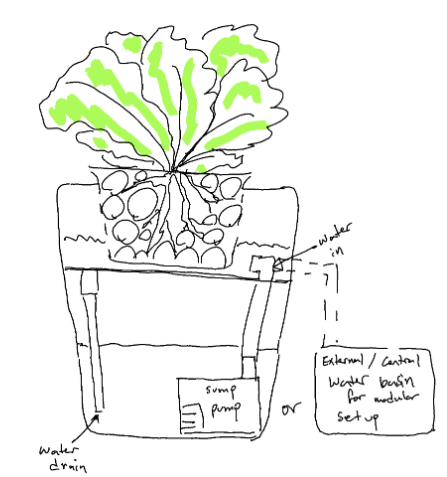
A modular pod system with multiple plants that meets our main project description. The MVP pod will automate simple aspects of plant growth such as light, nutrient levels, temperature and humidity. The respective sensors that we will use to detect and monitor these factors of plant growth are luminance sensors, total dissolved solid (TDS), and temperature and humidity sensors.
Shown below is our MVP concept sketch.
Learning Goals
Daeyoung Kim
- Practice iterative approach in prototyping
- Deploy fullstack web app through AWS Amplify
- Learn how to integrate and communicate with different electronic devices (I2C, MQTT)

Dokyun Kim
- Get more familiar with using microcontrollers
- Learn more circuit-related things
- Gain familiarity with AWS services

Maricela Garibay
- Have some general understanding of every element of the project
- Do some CAD
- Learn more electronics
- Better documentation
- More team bonding

Paige Gee
- Refresh on my MechE skills (CAD, fabrication)
- Learn some electronics
- Gain a broad understanding of relevant software
- Have good team communication
Satchel Schiavo
- Be involved in researching what different parts are safe and easy to use and manufacturing pieces in the shop
- Figure out best ways of waterproofing
- Build mechanical integration for water parts using pre-existing materials
- 3D print and laser cut a lot!